Peer Community for Families & Caregivers

You don't have to navigate neurodiversity alone.

Connect with parents and caregivers raising children with autism, ADHD, physical or cognitive disabilities, and speech delays. Share lived wisdom, find local resources, and support each other.

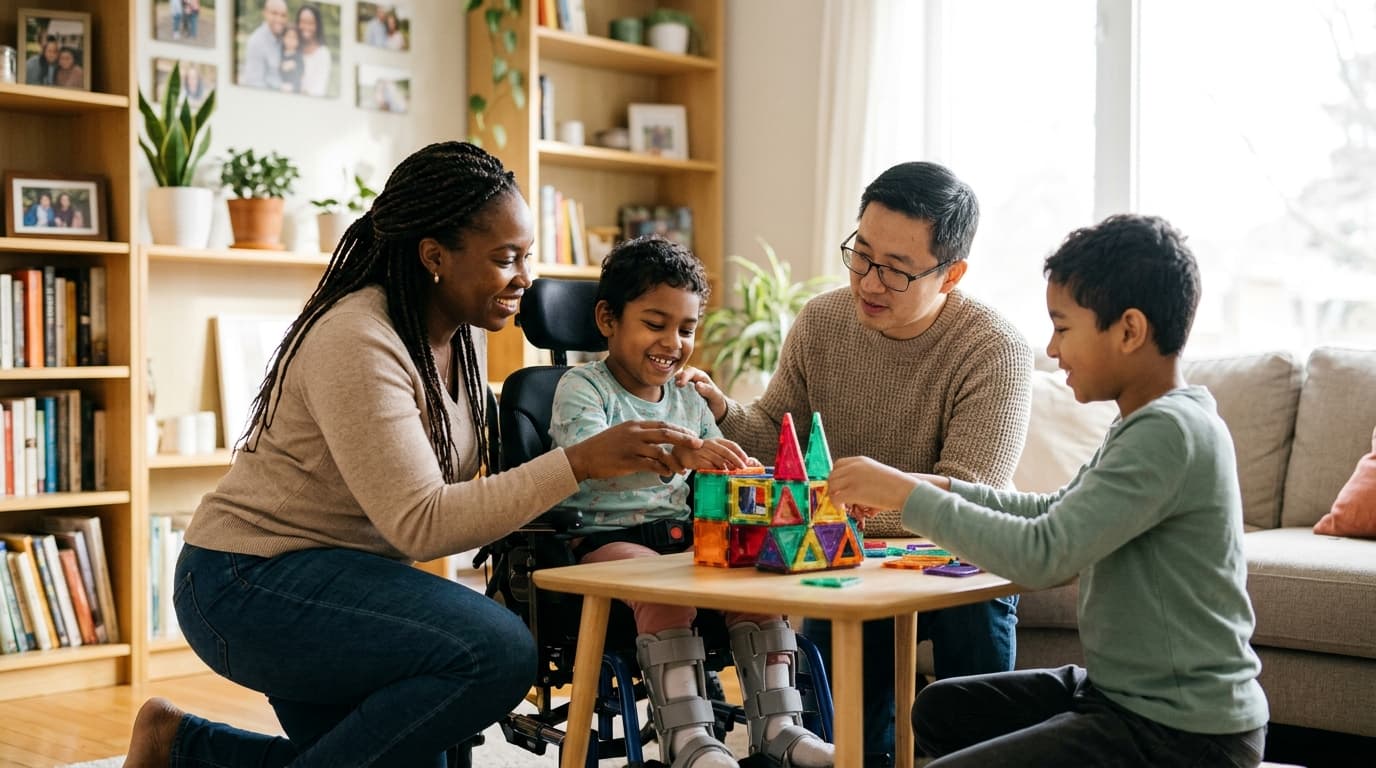
A loving family and child facing disabilities playing joyfully together

Anonymous & Private

Protect your child's identity while asking vulnerable questions.

Moderated Sanctuary

No parent-shaming, judgment, or unverified claims.

Real Wisdom

Therapy insights, school accommodations, and daily coping tools.

🔥 HotNewTop
All Care Circles
c/autism•Posted by Fatima_MomSensory Advice10/28/2026

Bedtime transitions & sensory wind-down routines that cut night awakenings in half

We struggled for over two years with our 6-year-old taking 2 to 3 hours to fall asleep, with frequent dysregulation at bedtime. After consulting our occupational therapist and adjusting sensory inputs, here is the evening routine that brought calm to our home: 1. **Light & Sound Damping (60 mins before bed)**: We switch off overhead fluorescent lights and rely only on warm 2200K dim bedside lamps. White noise machine turns on 30 minutes before sleep. 2. **Proprioceptive Heavy Work**: 10 minutes of gentle animal walks (bear crawls, wheelbarrow) or pushing a weighted laundry basket across the carpet to organize the nervous system. 3. **Compression Lycra Sheet**: This was a total game-changer for proprioceptive sensory seeking. It fits snugly over the mattress like a sleeve and provides consistent deep-pressure touch without retaining too much heat. 4. **Visual Sand Timer**: Traditional clocks caused anxiety, but a silent 15-minute liquid motion hourglass gives a calm visual marker when storytime is coming to a close. Every child's sensory profile is unique, but if bedtime has been feeling like a battleground, try gentle deep pressure and gradual transition cues. What has worked best for your children?

c/autism•Anonymous parent (OP)Wins & Milestones10/27/2026

First spontaneous two-way hug after 9 months of occupational therapy — celebrating a quiet milestone

I wanted to share this here because fellow caregivers are the only ones who understand the depth of these moments. My son has severe tactile defensiveness. For years, direct touch or hugs caused immediate sensory overload and fight-or-flight responses. We never pushed him and respected his boundaries, using gentle fist bumps and hand-over-heart signals instead. This afternoon, while we were sitting together on the carpet stacking soft blocks, he leaned his head against my shoulder, wrapped both arms around my waist, and stayed there for almost 30 seconds. No words, just pure trust and peace. To every parent wondering if the slow, patient therapy sessions are making a difference: progress isn't loud, but it is real.

c/adhd•Posted by Rashid_KAdvice10/28/2026

Visual magnetic morning checklist: How we cut breakfast departure meltdowns in half

Mornings used to involve repeating 'put your socks on' twenty-four times, escalating into frustration before 8:00 AM. Executive dysfunction makes multi-step verbal instructions vanish in seconds. Here is the setup that finally gave our 8-year-old independence: - **Magnetic Flip Board**: A two-sided magnetic strip on the hallway door. Each item has a pictorial icon: (1) Wash face, (2) Dress, (3) Breakfast, (4) Brush teeth, (5) Pack backpack, (6) Shoes on. - **The 'Flip' Satisfaction**: When a task is done, he physically flips the magnet over to reveal a green checkmark. The physical kinetic movement provides immediate dopamine. - **Audio Timer Playlist**: Instead of a generic alarm, we have a fun 12-minute 3-song playlist. When the last song plays, he knows shoes are happening. Zero yelling this week for the first time this school term. If executive function is your child's hurdle, replace verbal reminders with visual and kinetic anchors.

c/adhd•Posted by Sara_CaregiverSchool & IEPs10/27/2026

Quiet fidget tools that teachers actually allow in the classroom without confiscation

Finding fidgets that satisfy the sensory urge to move while remaining silent and non-distracting to classmates took a lot of trial and error. Here are the ones our school teacher approved and welcomed: 1. **Desk Chair Resistance Bands**: Heavy rubber band wrapped around the front two chair legs. Allows quiet kicking and bouncing with feet beneath the desk. 2. **Marble Mesh Sleeves**: Small nylon tube with a captured glass marble. Completely silent and fits inside a blazer or sweater pocket. 3. **Rough Textured 'Monkey Ring' Grips**: Fits on pencils for tactile finger stimulation during listening periods. Avoid pop-its or anything with clicking switches in classrooms — they attract peer attention and get banned quickly.

c/dyslexia•Posted by Bilal_AhmedResource10/27/2026

Pairing audiobooks with OpenDyslexic enlarged font: Our 9-year-old rediscovered storytelling

When decoding requires 90% of a child's mental bandwidth, comprehension and the sheer joy of stories disappear. Our daughter used to burst into tears whenever reading time was mentioned. Two changes transformed her relationship with books over the last four months: - **Ear-Reading & Eye-Reading Together (Immersion Reading)**: She listens to high-quality audiobooks on headphones while following the text on an e-reader set to 1.5 line spacing and OpenDyslexic font. - **Graphic Novels**: High visual context bridges vocabulary gaps and eliminates the wall of text intimidation. Series like *Investigators* and *Amulet* helped her realize she loves reading narrative plots. Her vocabulary scores shot up, but more importantly, her confidence returned. Don't hesitate to lean on assistive audio tools!

c/dyslexia•Anonymous parent (OP)Solidarity / Vent10/27/2026

Handling evening homework fatigue when reading takes 3x the cognitive effort

By 5 PM, neurodivergent kids have spent 6 straight hours working at 200% cognitive capacity just to track worksheets and keep up with peer expectations. When homework starts, meltdowns are almost inevitable. We agreed with her class teacher on an 'Accommodation of Time Limit': - 20 minutes maximum on reading tasks. - If unfinished after 20 minutes of focused effort, parent signs off on the planner and work ceases. Protecting your child's evening emotional well-being is more important than completing every repetitive worksheet. Has anyone else negotiated time-cap accommodations with their school?

c/speech-delay•Posted by Ayesha_SLP_ParentTherapy & Clinics10/28/2026

Introducing low-tech AAC picture cards (PECS) at home: What we wish we knew on day one

When our speech-language pathologist suggested Augmentative and Alternative Communication (AAC) cards, I had a misconception that introducing cards might delay natural speech. In reality, AAC gave our daughter an immediate bridge to express needs, which dramatically reduced frustration tantrums. Over time, having the picture representation actually encouraged verbal approximations. Three key lessons from our first six months: 1. **Focus on High-Motivation Items First**: Don't start with 'sit' or 'wash hands'. Start with bubbles, trampoline, mango slices, or whatever lights up their eyes. 2. **Keep the Board at Child Eye Level**: Stick velcro strips on the refrigerator and living room toy bins, not tucked away in a school bag. 3. **Honor Every Communication Attempt**: Pointing, eye gaze, or handing the card counts as valid speech. Always model the spoken word gently without withholding the reward.

c/speech-delay•Posted by Hassan_DadWins & Milestones10/27/2026

At 4 years and 2 months, our non-verbal toddler spontaneously asked for 'water please'!

I am writing this with happy tears. For the last 20 months, our communication was purely gestures, hand-leading, and gentle sign language. Tonight, during warm bath time with his floating boats, he looked up, smiled, tapped his cup, and clearly enunciated: 'Water... please'. It may seem small to someone outside our world, but to our family it is everything. Keep practicing during joyful water and sensory play — relaxation makes speech so much more accessible.